





What to Prepare Before Your First Factory Visit to China
Recently, I have been hosting several overseas clients visiting factories in China. Some of them were coming to China for the first time. They were not unfamiliar with factory visits themselves, but many were still unfamiliar with how everyday things work here — especially payments, local transportation, and the practical tools people rely on from their phones.
Because of that, I noticed something quite clearly: for many first-time visitors, the most stressful part is often not the factory meeting itself. It is everything around it — how to pay, how to book a ride, how to take a high-speed train, how to use the subway, and how to move around smoothly once they arrive.
That is exactly why I wanted to write this article. If this is your first time coming to China, especially for factory visits, preparing a few practical things in advance can make the trip much easier to manage.
The first and most important step is setting up Alipay and WeChat. In China, these are no longer optional apps. They are part of daily life. Paying for meals, buying small items, calling a ride, and even using public transportation often depends on mobile payment. For first-time visitors, the safest approach is to download both apps before the trip, set them up properly, and connect a usable bank card in advance. If this is already done before arrival, many small but frustrating moments become much easier.
The second useful tool is DiDi. For many overseas visitors, one of the first concerns after landing is how to get from the airport to the hotel, and then from the hotel to the factory. In practice, using DiDi is usually much easier than trying to find a taxi on the spot, especially if you are not comfortable with the language or with local addresses. If the app is already installed and set up before the trip, local travel becomes much simpler.
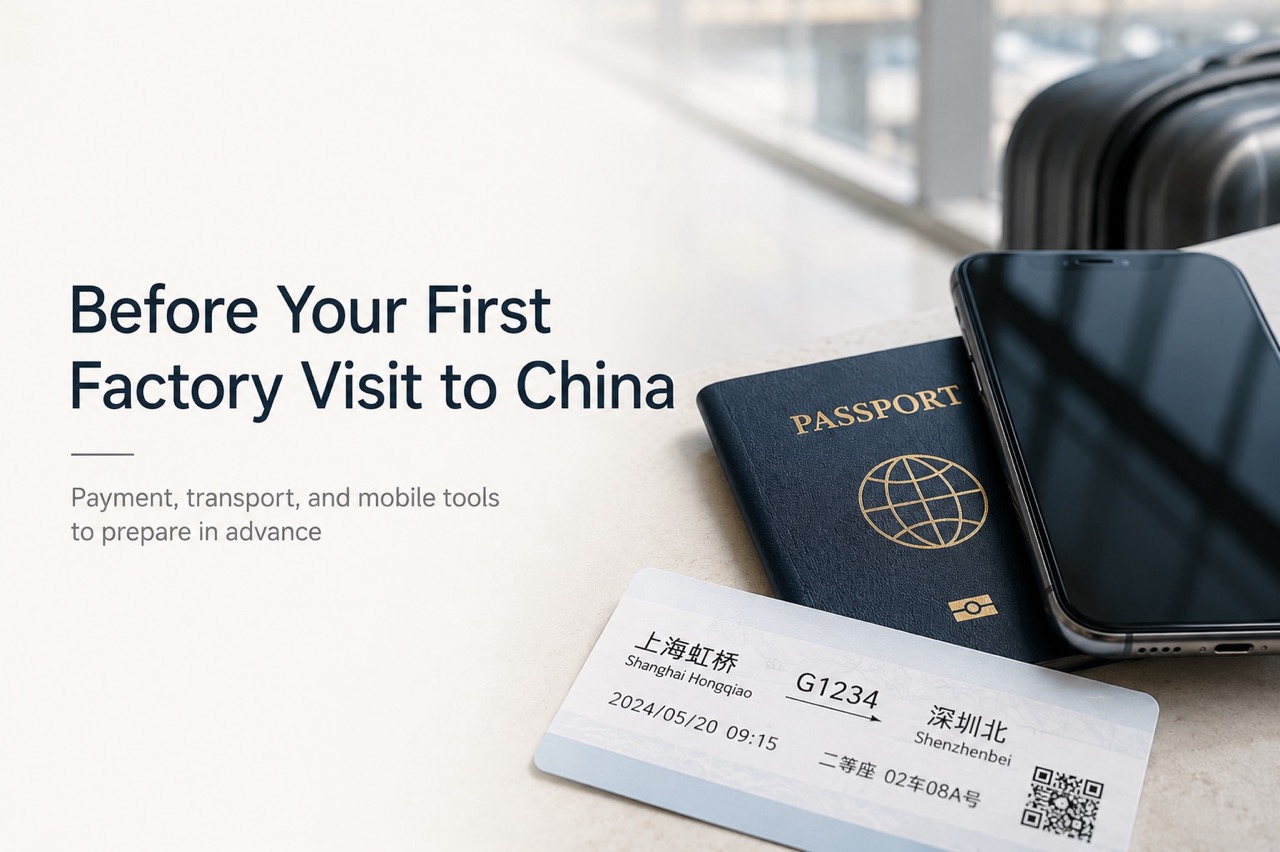
The third important point is high-speed rail. If the trip involves moving between cities, high-speed rail is often one of the most efficient options in China. The safest approach is to book through the official railway platform whenever possible. In most cases, tickets can be purchased using passport information, and the same passport is then used as the ID document when entering, exiting, and boarding. In simple terms, if the ticket is booked with a passport, it is best to stay consistent and use that same passport throughout the journey.
The fourth point is subway travel. Many first-time visitors assume they need to buy physical tickets every time, but in many cities, using a QR code through Alipay is usually much easier. Once it is set up, getting in and out of the subway becomes quick and straightforward. Physical tickets are still possible, of course, but using a QR code is usually more convenient, especially for visitors who are still getting used to everything.
The fifth point is maps and translation tools. A translation app is obviously necessary, but map tools matter just as much. Many visitors naturally rely on the apps they normally use in their own countries, but in China, local map services are often much more useful for addresses, local navigation, factory locations, and route planning. Having a reliable map app ready in advance can save a surprising amount of time.
Another small but very practical step is saving important addresses in Chinese before arrival. This includes the hotel, factory, airport, and railway station. It may sound minor, but it becomes extremely useful when calling a car, checking directions, or showing the destination to someone locally. In real situations, Chinese addresses are usually much more useful than relying only on English names.
Internet access also needs to be planned in advance. Payments, ride-hailing, maps, train tickets, subway QR codes, and communication all depend on mobile data. If your phone is not properly connected, all of these tools become harder to use. So before coming to China, it is worth deciding in advance whether to use international roaming, an eSIM, or a local SIM card.
One more practical point: do not make the schedule too tight. Many first-time visitors want to see as many factories as possible in a short time, which is understandable. But in reality, travel time between cities, stations, hotels, and factories can easily take longer than expected. On top of that, if this is your first time in China, simply getting used to payments, transport, and daily routines already takes energy. Leaving some room in the schedule often makes the whole trip much smoother.
In the end, for a first factory visit to China, the most important preparation is not your suitcase, but the practical tools on your phone. If payment, ride-hailing, railway, subway, maps, and internet access are all prepared in advance, the trip becomes much easier to handle. That allows you to focus on what really matters — visiting factories, checking samples, evaluating development ability, and having productive discussions — instead of losing time to avoidable logistical problems.
If I had to summarize it in one sentence, it would be this: before coming to China for the first time, prepare payment, transportation, maps, and internet access first. These may sound like small details, but they often decide whether the first day feels smooth or stressful.
Related Posts