



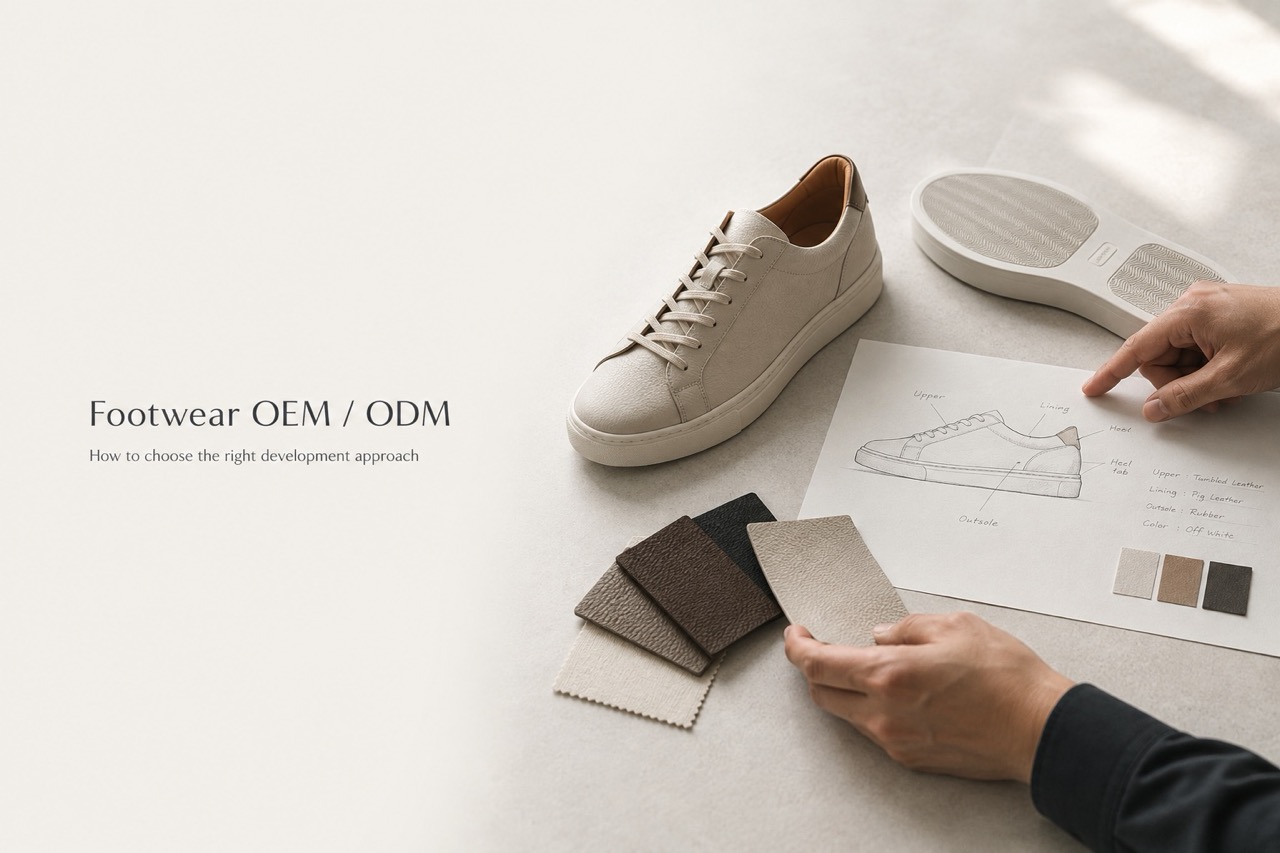
Footwear OEM vs ODM: What Is the Difference and Which Is Right for Your Brand?
When a brand begins looking for a footwear manufacturer, two terms appear frequently: OEM and ODM.
They are often used as simple labels, but in actual footwear development the difference is not always absolute.
A brand may already have a complete shoe design and only need a factory to manufacture it. Another brand may have only reference images and a general concept and need support with materials, outsole selection, construction, and sample development.
Many projects fall somewhere between these two situations.
For footwear brands, the more practical question is therefore not simply:
“Is this OEM or ODM?”
The more important question is:
“How much development support does the brand need from the supplier?”
Understanding this makes it easier to select the right footwear partner and avoid misunderstandings during sampling and bulk production.
What Is Footwear OEM?
OEM stands for Original Equipment Manufacturer.
In footwear production, OEM commonly refers to a project in which the brand already controls most of the product concept and specification, while the supplier is responsible for turning that specification into a manufacturable shoe.
The brand may already provide:
- shoe drawings;
- technical specifications;
- reference samples;
- approved materials;
- outsole specifications;
- logos and branding;
- colorways;
- size ranges;
- packaging requirements.
The footwear supplier then supports the manufacturing side of the project.
This may include:
- checking whether the design can be produced;
- sourcing materials and components;
- preparing shoe lasts;
- confirming outsole compatibility;
- developing samples;
- making pattern adjustments;
- managing sample revisions;
- preparing for bulk production;
- quality control;
- shipment coordination.
OEM does not mean that the supplier simply copies a drawing without giving technical feedback.
A good footwear OEM partner should still identify production risks and explain when a design, material, outsole, or construction needs adjustment.
The difference is that the brand remains the main owner of the product design and development direction.
What Is Footwear ODM?
ODM stands for Original Design Manufacturer.
In an ODM project, the supplier usually participates more deeply in the development of the product.
The brand may begin with:
- a mood board;
- reference images;
- a general shoe category;
- a target retail price;
- a preferred silhouette;
- a material direction;
- an idea for a new collection.
Instead of receiving a complete technical package, the supplier helps turn that direction into a workable footwear product.
Depending on the project, ODM support may include:
- selecting an appropriate shoe construction;
- proposing an existing outsole;
- developing a custom outsole;
- recommending materials;
- adjusting proportions;
- selecting or developing a last;
- preparing the upper structure;
- developing samples from reference images;
- suggesting alternative solutions when the original concept is difficult to produce.
In this type of project, the supplier contributes more actively to product development.
However, ODM does not necessarily mean that the supplier independently designs the entire shoe.
In many footwear projects, the brand still controls the overall aesthetic direction while the supplier handles the technical development required to make the concept manufacturable.
Footwear OEM and ODM Are Often Not Completely Separate
In practice, many footwear projects combine elements of both OEM and ODM.
For example, a brand may provide a detailed upper design but ask the supplier to find a suitable existing outsole.
Another brand may provide a reference shoe and ask for changes to the material, sole thickness, toe shape, and branding.
A designer may have a complete visual concept but not know:
- which material can reproduce the intended effect;
- which outsole fits the design;
- whether a new mold is required;
- how the shoe should be constructed;
- how the design will affect MOQ and cost.
In these cases, the project cannot be described as purely OEM or purely ODM.
The brand controls part of the development, while the footwear supplier contributes technical solutions.
For this reason, the most important issue is to define the development scope before sampling begins.
A Simple Way to Understand the Difference
A useful way to think about footwear OEM and ODM is:
OEM:
The brand knows what it wants to make and needs a supplier to develop and manufacture it correctly.
ODM:
The brand knows the direction it wants to take but needs more support turning that direction into a manufacturable shoe.
Between these two situations is a wide range of hybrid development.
For most independent and growing footwear brands, this hybrid model is common.
When Is OEM More Suitable?
OEM is usually more suitable when the brand already has a relatively complete development system.
For example:
- an in-house footwear designer is available;
- technical drawings already exist;
- lasts and outsoles have already been selected;
- materials are specified;
- an existing shoe needs to be transferred to a new supplier;
- a previous sample is available as a production reference.
In these projects, the supplier's role is mainly to reproduce the approved direction accurately and manage production.
The advantage is that the brand retains a high level of control over the product.
However, detailed specifications are important.
If the technical information is incomplete, even an OEM project may require additional development work before a stable sample can be produced.
When Is ODM More Suitable?
ODM can be more suitable when the brand has a product concept but does not yet have a complete footwear development team.
For example:
- the brand is developing shoes for the first time;
- only reference images are available;
- the preferred outsole has not been selected;
- materials are not yet confirmed;
- the brand needs help understanding construction options;
- the product must be developed around a target cost or MOQ.
In this situation, the supplier becomes more involved in converting the concept into an actual product.
This can reduce the amount of technical preparation required from the brand.
However, the brand should still provide a clear creative direction.
ODM works best when the supplier understands what the brand is trying to achieve rather than being asked to “design something” without a defined target.
What Information Should a Brand Prepare?
Whether a project is OEM, ODM, or a combination of both, better initial information usually leads to more efficient development.
Useful information includes:
- reference images or drawings;
- shoe category;
- intended use;
- preferred construction method, if known;
- material direction;
- outsole direction;
- target quantity;
- size range;
- target price;
- target delivery date;
- sales market.
Not every project needs a complete technical specification at the beginning.
However, the more clearly the brand can communicate its priorities, the easier it is for the supplier to recommend a practical development route.
For example, a project prioritizing a highly original outsole may require mold development and a larger initial investment.
A project prioritizing a small initial order may be better suited to an existing outsole and more readily available materials.
These decisions should be made early.
Existing Outsole or Custom Outsole?
Outsole selection is one of the areas where the boundary between OEM and ODM frequently becomes unclear.
A brand may already have a complete upper design but still require the supplier to select the outsole.
There are generally two approaches.
Existing Outsole
Using an existing outsole can help reduce:
- mold cost;
- development time;
- initial investment;
- minimum-order pressure.
It is often practical for first projects or smaller orders.
The supplier can search available outsole options and evaluate which one works with the last, upper design, shoe category, and target price.
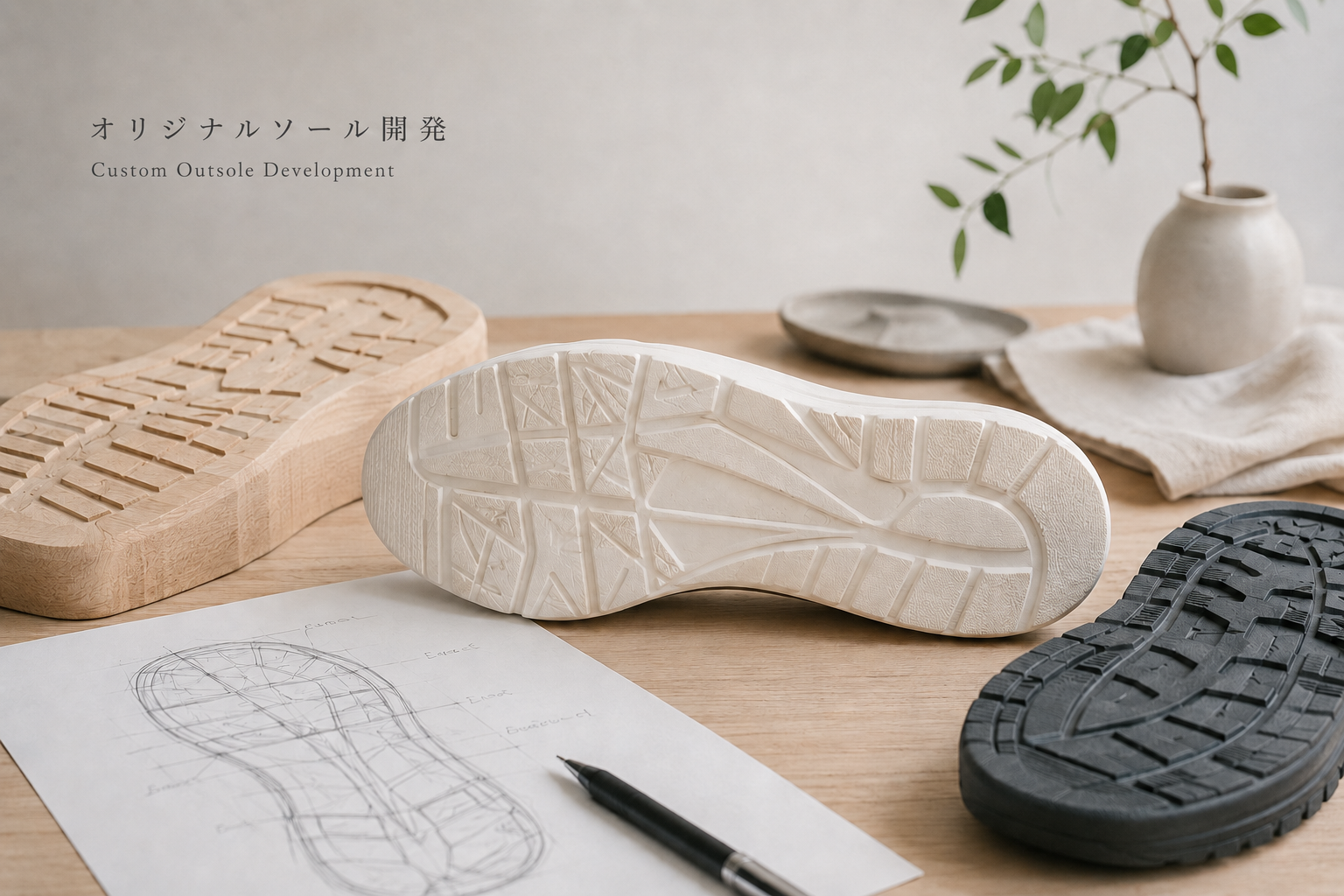
Custom Outsole
A custom outsole gives the brand greater control over:
- shape;
- sidewall design;
- tread pattern;
- logo placement;
- thickness;
- overall product identity.
However, custom outsole development requires additional development work and mold investment.
The process may include outsole design, a physical master model, mold making, trial outsole production, and complete shoe sampling.
This is a typical area where a supplier may provide ODM-type development support even when the rest of the shoe is developed as an OEM project.
MOQ Also Depends on the Development Method
OEM and ODM do not automatically determine MOQ.
Footwear MOQ depends on several production conditions, including:
- upper material minimums;
- outsole availability;
- number of colors;
- size range;
- production method;
- custom molds;
- special components;
- packaging.
A shoe using an existing outsole and standard materials may be easier to produce in a smaller initial quantity.
A highly customized shoe using original molds and specially developed materials usually requires more investment and may have different minimum-production conditions.
For this reason, MOQ should be evaluated based on the actual specification rather than simply asking whether an OEM or ODM project has a lower minimum.
Sampling Is Where the Development Becomes Real
Whether a project begins as OEM or ODM, the sample stage is where the concept becomes a physical product.
During sampling, the brand and supplier may need to confirm:
- overall shape;
- fit;
- last;
- outsole;
- material;
- color;
- stitching;
- padding;
- logos;
- construction;
- component positioning.
The first sample is not always expected to be the final production sample.
Its purpose is to identify which parts of the design work correctly and which parts need adjustment.
Clear sample comments and revision records are especially important in footwear because a change in one area can affect several other parts of the shoe.
For example, changing the upper material may affect fit and lasting.
Changing the outsole may require a different last or upper proportion.
This is why footwear development requires coordination rather than simply producing a sample from a picture.
The Supplier Should Explain What Is Possible and What Is Not
One of the most important differences between a basic production supplier and a capable footwear development partner is the ability to identify technical limitations.
A supplier should be able to explain:
- whether a reference design can be reproduced;
- whether an existing outsole can be used;
- whether a new mold is required;
- which materials are suitable;
- which details may cause production problems;
- which requirements affect MOQ;
- which requirements affect cost;
- which parts still need development.
A supplier that simply agrees with every request may create problems later.
In footwear production, some limitations only become clear after the construction, materials, and quantity are reviewed together.
Realistic technical feedback at the beginning is usually more valuable than an unrealistic promise.
How Asahihara Co., Ltd. Supports Footwear OEM and ODM Projects
Asahihara Co., Ltd. supports footwear OEM and ODM development and production management in China.
Some clients come to us with complete shoe designs and specifications.
Others have only reference images, an existing product, or an early-stage concept.
Our role changes according to the project.
Depending on the development stage, support may include:
- Japanese and English communication;
- project organization;
- technical specification coordination;
- shoe last selection and development;
- existing outsole sourcing;
- custom outsole development;
- material sourcing;
- sample development;
- sample revision management;
- production-site selection;
- production follow-up;
- quality control;
- third-party inspection coordination;
- shipment support.
Our footwear factory in Wenzhou serves as one of our core production bases. We also work with selected partner factories when another production region or factory is more suitable for the shoe category, construction method, materials, quantity, or quality requirements.
The goal is not to force every project into the same production system.
The goal is to understand what the brand has already prepared, identify what still needs to be developed, and build a practical production plan around the project.
OEM or ODM: Which Should Your Brand Choose?
There is no need to decide too strictly between OEM and ODM at the beginning.
A brand with complete specifications may need mostly OEM production support.
A brand with an early-stage concept may require more ODM development.
Many projects naturally use both.
The more useful questions are:
- What has already been decided?
- What still needs to be developed?
- Which parts require technical support?
- What is the target quantity?
- What is the target price?
- How original does the product need to be?
- How much development time is available?
Once these points are clear, the appropriate development method becomes much easier to define.
Conclusion
Footwear OEM and ODM describe different levels of supplier involvement, but real shoe development is rarely divided into two completely separate categories.
OEM is generally suitable when the brand already controls most of the product design and needs reliable development and manufacturing support.
ODM is useful when the brand needs greater support with materials, outsoles, construction, specifications, or product development.
In many cases, the best solution is somewhere between the two.
What matters most is having a footwear partner that understands the brand’s design direction, explains production limitations clearly, and manages the transition from concept to sample and from sample to bulk production.
Brands planning a new footwear project may contact Asahihara Co., Ltd. with reference images, product category, expected quantity, size range, target price, and development schedule.
Related Posts