




How Apparel OEM Production Is Managed in China From Sample to Bulk Production
If you are planning to develop apparel through OEM production in China, it is important to understand that the process is not just about design approval or price negotiation.
In reality, apparel production is a step-by-step system where each stage affects the next one, from sampling to bulk production. A clear understanding of this process can help reduce unnecessary revisions and production delays.
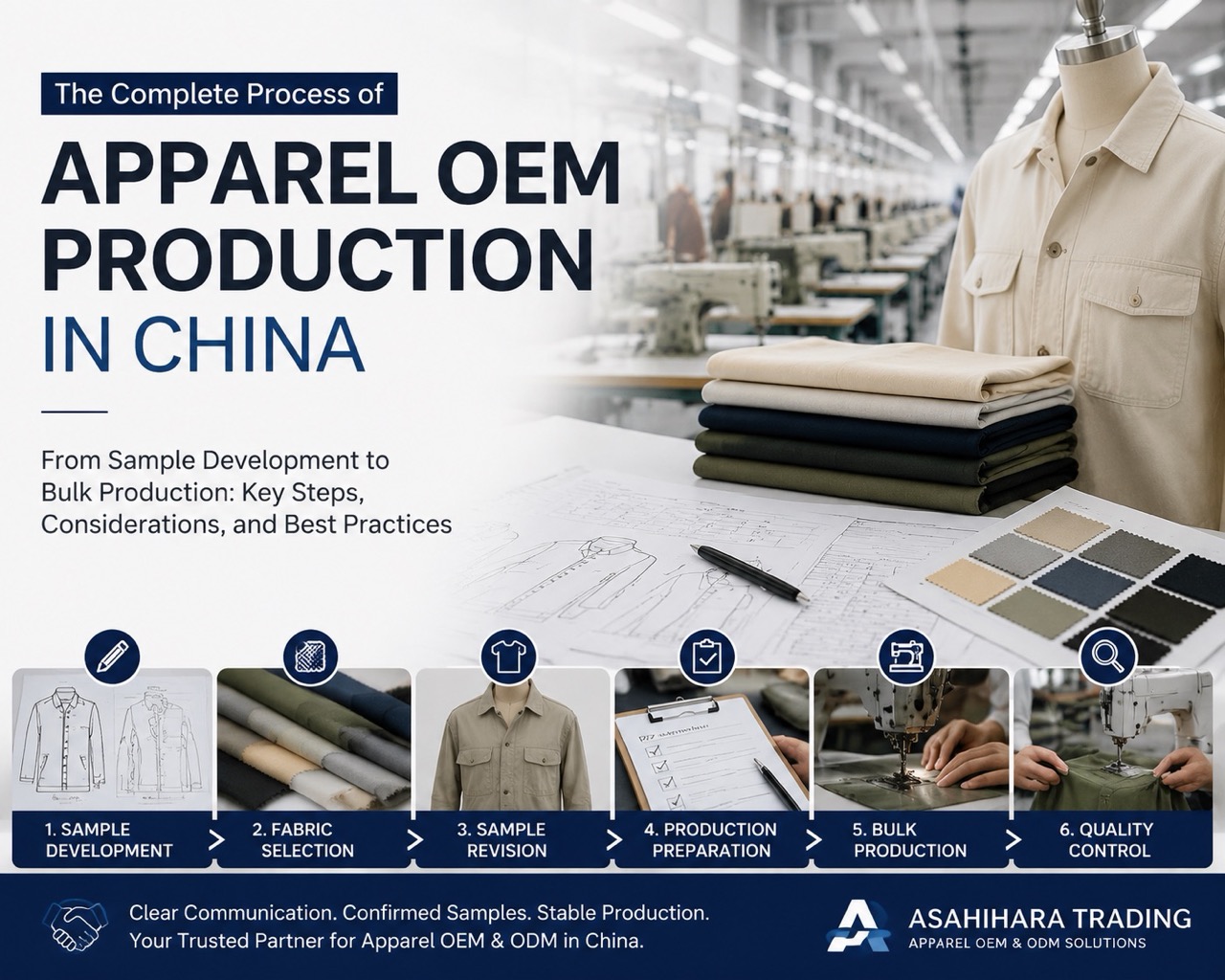
The process usually starts with sample development.
At this stage, a design idea is translated into a technical specification. This includes silhouette, construction, fabric direction, and basic pattern structure. Even small adjustments at this stage can affect cost, production stability, and lead time later in the process.
This is why the sample stage is not only about appearance. It is also about checking whether the design can actually be produced in bulk under real factory conditions.
Fabric selection plays a key role in this stage.
In apparel OEM production, fabric is not only a design choice but also a production constraint. Different fabrics have different minimum order requirements, shrinkage behavior, sewing stability, and finishing conditions.
This means that fabric decisions can directly influence both MOQ and production schedule, even before the garment production begins.
After the first sample is made, revisions are usually required.
It is very common that the first sample is not the final version. Adjustments may include fit correction, fabric replacement, stitching simplification, or proportion changes.
These revisions are not mistakes. They are part of the normal process of aligning design intention with production reality.
Once the sample is approved, the project moves into production preparation.
At this stage, the factory finalizes the pattern, size grading, and production planning. At the same time, materials, trims, labels, and packaging details are confirmed.
This stage is important because any missing or unclear detail can affect stability during bulk production.
Bulk production itself is not simply a scaled-up version of sampling.
It is a coordinated process involving cutting, sewing, finishing, and quality control. Each step must follow the confirmed sample, and even small inconsistencies can lead to quality variation.
This is why production management and QC are critical in apparel OEM projects, especially when working with overseas brands.
Another important factor is communication.
Many issues in apparel production are not caused by technical difficulty, but by unclear information in the early stages. When specifications, materials, or expectations are not clearly defined, problems often appear during production.
Clear communication and confirmed samples help reduce these risks significantly.
At Asahihara Trading, we support apparel OEM and ODM projects in China through sample development, fabric sourcing, specification adjustment, production coordination, QC, and bulk production follow-up.
Our focus is to make sure the transition from sample to production is stable and practical, not just theoretical.
For brands planning apparel development in China, understanding this process in advance can help avoid unnecessary revisions and improve overall production efficiency.
Related Posts